

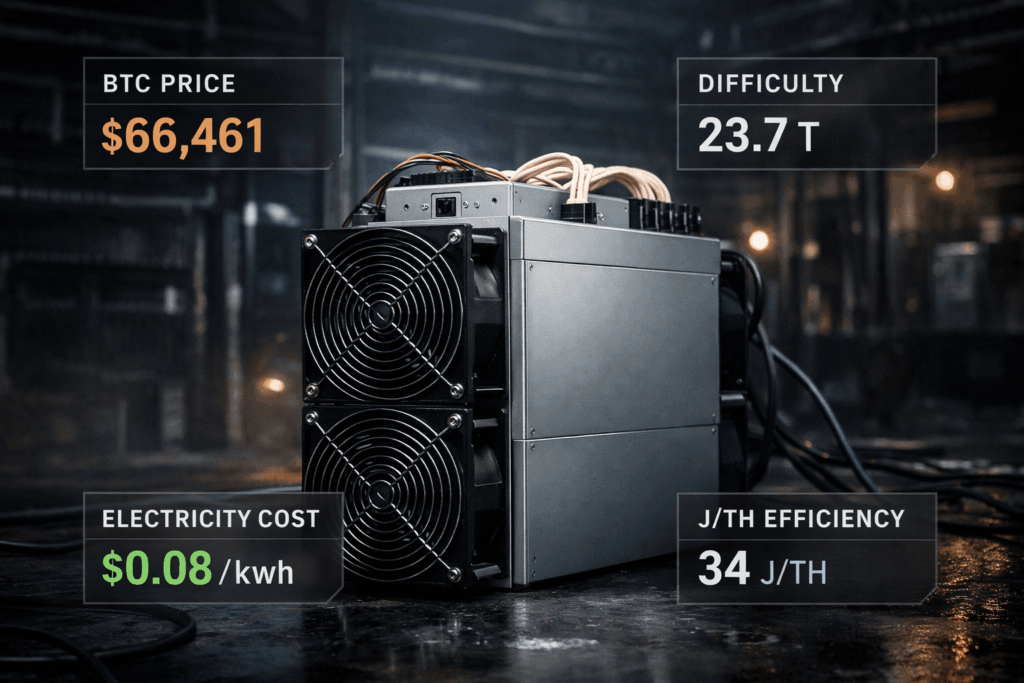
Bitcoin mining in 2026 is still profitable — but only for miners who understand the numbers. That is the real answer.
The lazy version of this topic is “Bitcoin went up, so mining must be profitable.” That is how beginners lose money. Mining is not a magic money printer. It is a capital-intensive business built on four moving variables: Bitcoin price, network difficulty, electricity cost, and ASIC efficiency. When those variables align, mining can generate strong cash flow. When they do not, even expensive hardware becomes a liability.
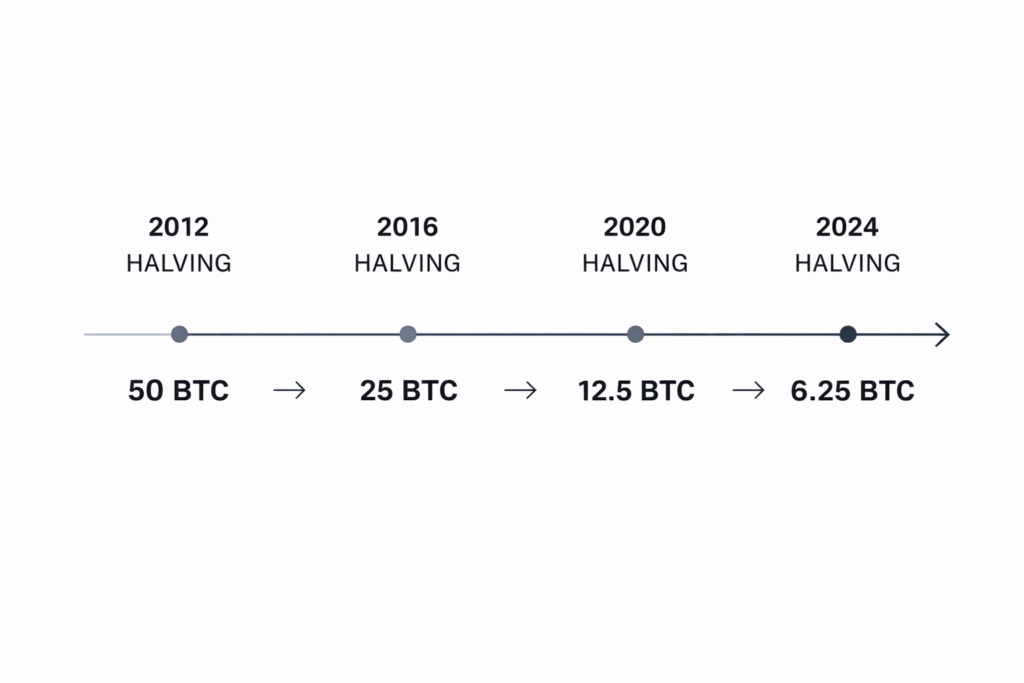
In 2026, that distinction matters more than ever. After the April 2024 halving, the Bitcoin block reward fell from 6.25 BTC to 3.125 BTC, cutting the new issuance paid to miners in half. That change did not kill mining, but it made the industry far less forgiving. By mid-March 2026, Bitcoin network difficulty was about 145.04T, the 7-day average network hashrate was about 949 EH/s, and spot hashprice was roughly $32.30 per PH/s/day. In plain English: competition remained brutal, revenue per unit of hash was tight, and operators with weak machines or expensive electricity were under pressure.
What changed after the halving?
The halving is the event most casual observers talk about, but few understand its actual effect on mining. The halving does not “end profitability.” What it does is compress miner revenue overnight. Before the 2024 halving, miners were competing for 6.25 BTC per block. After it, they were competing for 3.125 BTC per block, plus transaction fees. Braiins also noted that the daily new supply dropped from roughly 900 BTC to 450 BTC. That means miners need either a higher BTC price, better fee revenue, more efficient machines, lower power costs, or some combination of all four just to maintain the same economic position.
The more honest takeaway is this: mining in 2026 is no longer about whether Bitcoin exists as an opportunity. It is about whether your operation is efficient enough to survive in a market where the easy margin is gone. When block rewards are lower and network competition remains high, inefficiency gets punished fast.
What actually determines Bitcoin mining profitability?
Most people ask the wrong question. They ask, “How much can this miner make per day?” The better question is, “How much can this miner keep per day after real operating costs?”
Mining profitability comes down to a simple business equation:
Revenue = Hashrate output × network hashprice × uptime
Profit = Revenue − electricity − hosting − pool fees − cooling overhead − maintenance − hardware payback
Hashrate Index defines hashprice as the expected USD or BTC rewards that a miner can earn from a petahash or terahash of Bitcoin hashrate. Blockchain.com notes that Bitcoin difficulty adjusts every 2,016 blocks, roughly every two weeks, to keep average block production near ten minutes. That means mining revenue is not static. Even if BTC price stays strong, changing difficulty can squeeze margins.
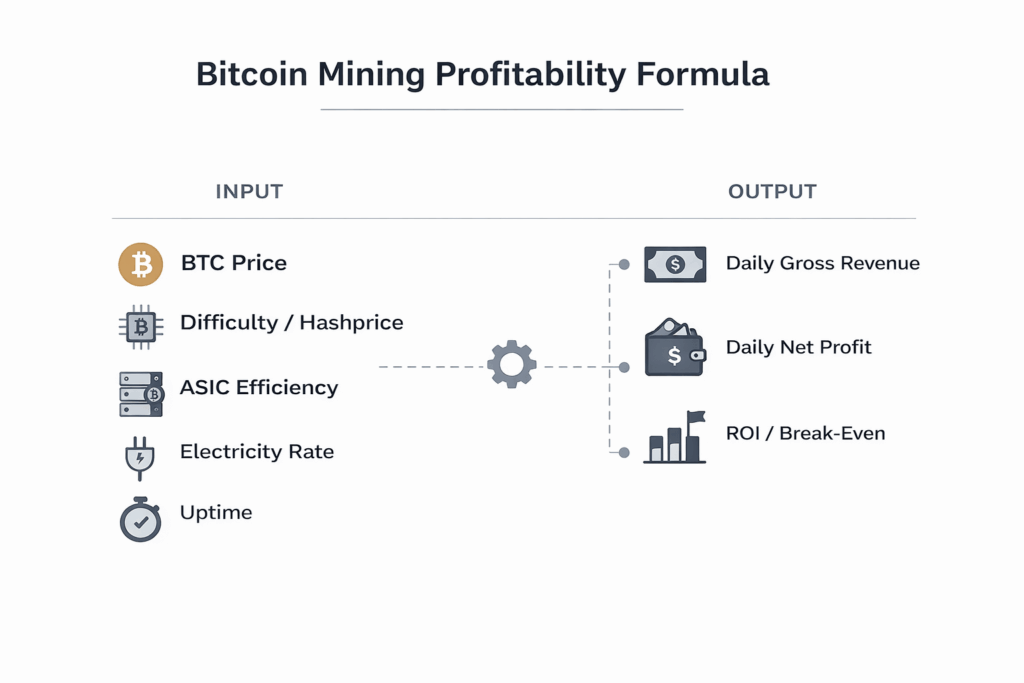
This is why calculators matter, but calculators are only as useful as the assumptions inside them. If you assume cheap electricity, perfect uptime, no downtime, and no extra cooling costs, you can make almost any miner look attractive. Real profitability comes from conservative assumptions, not optimistic screenshots.
Electricity is not a detail. It is the business model.
If someone asks whether Bitcoin mining is profitable in 2026, the first number they should tell you is not the Bitcoin price. It is their electricity rate.
That is because power cost is the hardest expense in the model. You can negotiate pool fees. You can improve firmware. You can optimize airflow. But if your electricity is expensive, you start every day already behind.
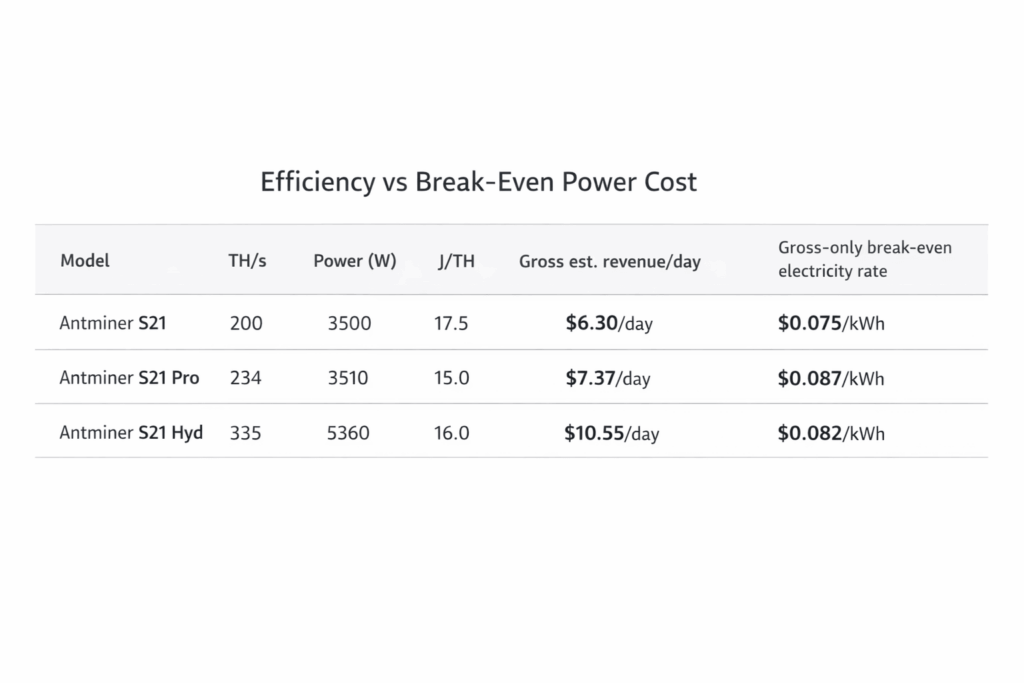
Let’s use real Bitmain hardware examples. The Antminer S21 is rated at 200 TH/s and 3,500 W, the Antminer S21 Pro at 234 TH/s and 3,510 W, and the Antminer S21 Hyd. at 335 TH/s and 5,360 W. Their stated efficiencies are roughly 17.5 J/TH, 15 J/TH, and 16 J/TH respectively.
Now apply the mid-March 2026 spot hashprice of about $32.30 per PH/s/day. A simple revenue estimate gives roughly:
- S21 (200 TH/s): about $6.46/day gross
- S21 Pro (234 TH/s): about $7.56/day gross
- S21 Hyd. (335 TH/s): about $10.82/day gross
Those are gross revenue estimates before power, fees, cooling, or hosting. They are not profit. They are the top line. The bottom line is where most bad buying decisions get exposed. The revenue assumptions are based on Hashrate Index’s mid-March 2026 hashprice, while the machine specs come from Bitmain; the arithmetic is a direct calculation from those inputs.
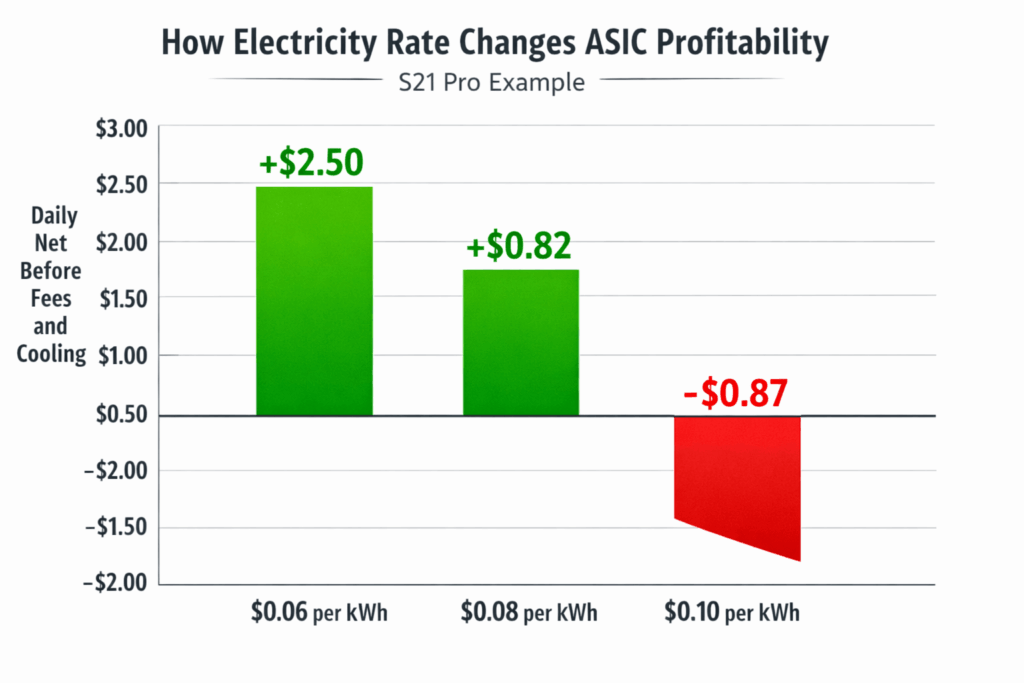
Take the S21 Pro as the clearest example. At 3.51 kW, it uses about 84.24 kWh per day. That means:
- at $0.06/kWh, power costs are about $5.05/day
- at $0.08/kWh, power costs are about $6.74/day
- at $0.10/kWh, power costs are about $8.42/day
Against an estimated $7.56/day in gross revenue, that leaves about $2.50/day at $0.06 power, about $0.82/day at $0.08 power, and the machine goes negative before other costs at $0.10 power. That is the whole story in one example. Same machine. Same Bitcoin. Same network. Different electricity rate. Completely different business outcome. The numbers come from direct calculation using Bitmain’s published wattage and Hashrate Index’s reported hashprice.
ASIC efficiency matters more in 2026 than it did a few years ago
There was a time when buying almost any decent Bitcoin ASIC could work if BTC price ran hard enough. That period is over.
Today, efficiency is not a spec-sheet vanity metric. It is your survival rate. Luxor’s March 16, 2026 roundup estimated that, based on fleetwide efficiency, Bitcoin mining operations were earning roughly $78 per MWh for fleets under 19 J/TH, $60 per MWh for fleets in the 19–25 J/TH range, and $42 per MWh for fleets in the 25–38 J/TH range. That gap explains why newer-generation fleets can stay alive while older fleets get squeezed out.
This is why the jump from older hardware to something like an S21-class machine is not cosmetic. It changes the break-even threshold. Using the same mid-March 2026 revenue snapshot, the rough gross-only break-even electricity rate is about:
- S21: around $0.077/kWh
- S21 Pro: around $0.090/kWh
- S21 Hyd.: around $0.084/kWh
Those figures do not include pool fees, downtime, maintenance, hosting margins, or extra cooling infrastructure. Real break-even is lower. But even this rough comparison shows the point: more efficient miners buy you breathing room. In a low-margin environment, breathing room is everything. The thresholds are calculated directly from the published machine power specs and the cited hashprice snapshot.
Why Bitcoin price alone does not guarantee good ROI
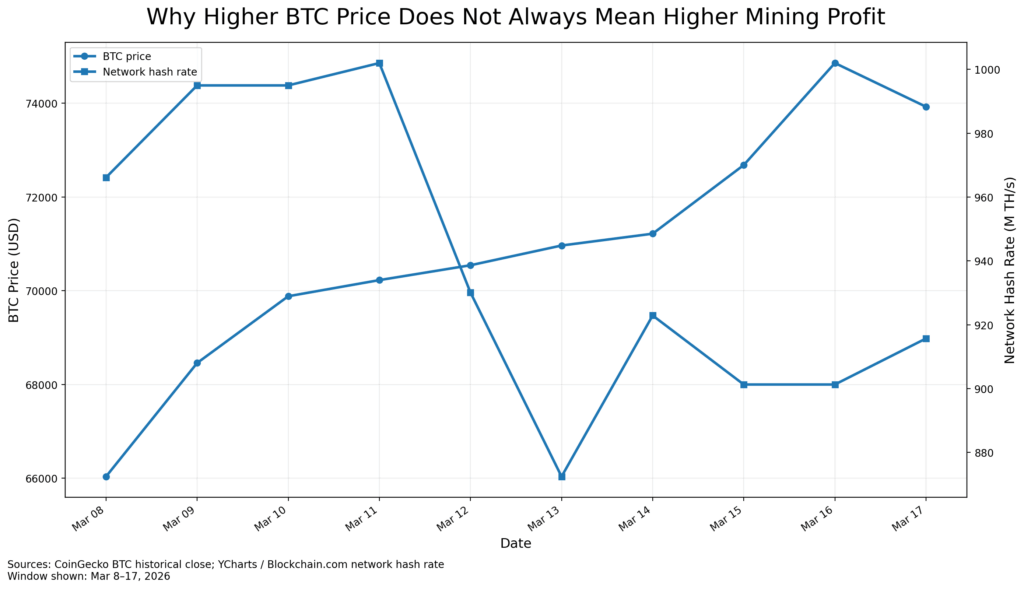
One of the most common mistakes in mining is assuming that if Bitcoin price rises, profitability automatically rises at the same pace.
That is not how this market works. When Bitcoin price improves, more miners come online, older fleets stay active longer, and network difficulty tends to absorb some of that upside over time. Braiins notes that difficulty changes about 24 times per year, and that long-term ROI modeling has to account for difficulty growth, not just price growth. In other words, the market does not let easy margins sit untouched for long.
That pressure was still visible in March 2026. Luxor’s forward market estimate in the Hashrate Index roundup priced an average hashprice of about $32.17 over the next six months — a useful reminder that even with a stronger Bitcoin market, miners were not being promised explosive margin expansion. Fees were also a relatively small part of block rewards that week, with transaction fees making up just 0.64% of block rewards. That matters because fees were not doing much to rescue weak operations.
Can home mining still be profitable?
Yes — but only under narrower conditions than most people want to hear.
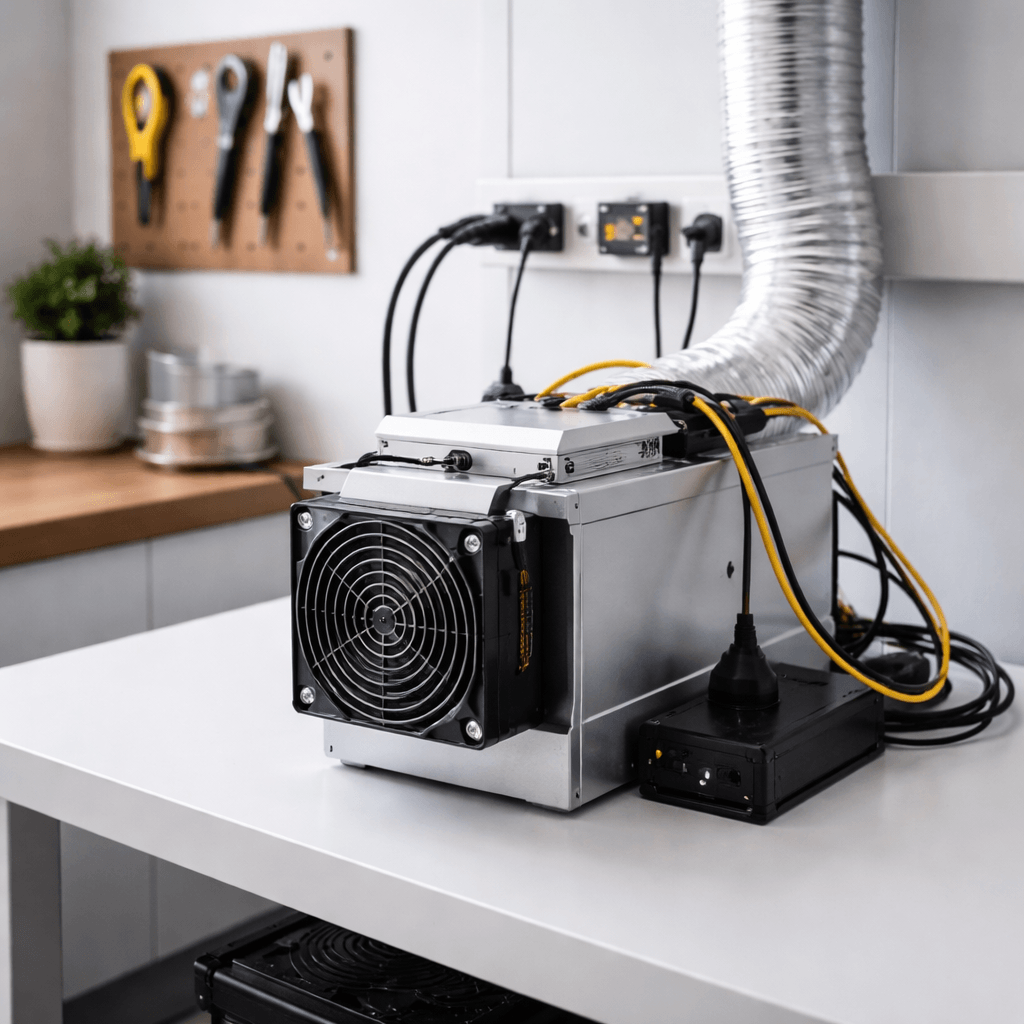
Home mining is still technically possible, and it still matters for decentralization. But Ledger’s practical guide makes the situation clear: modern Bitcoin mining is dominated by specialized ASIC hardware, large-scale operators, and cheap electricity. Ledger also notes that home setups may require cooling, power planning, wired internet, and serious upfront spend, and that it is increasingly difficult for the average home miner to generate significant returns because of high costs and competition.
So the real answer is this: home mining can make sense if you have unusually low electricity costs, good ventilation, realistic expectations, and a specific reason for doing it — such as heat reuse, long-term BTC accumulation, or learning the business at a small scale. It makes far less sense if you are paying standard residential electricity rates and expecting easy passive income.
So, is Bitcoin mining still profitable in 2026?
Yes — for efficient operators with the right inputs.
No — for people who buy hardware first and think later.
That is the cleanest answer.
In 2026, Bitcoin mining is still a viable business, but it is no longer forgiving. The halving reduced block rewards, network difficulty remains high, and margins are thin enough that electricity price and ASIC efficiency decide who stays profitable. A modern miner with efficient hardware and access to low-cost power can still build a solid operation. A buyer with expensive power and weak assumptions can lose money even with premium equipment.
That is why the smartest question in 2026 is not “Which ASIC makes the most revenue?” It is:
Which ASIC still makes sense at my electricity rate, in my market, with my expected ROI horizon?
That is the question serious miners ask. And serious miners usually make better decisions.
Looking for the right ASIC for your electricity rate and budget?
Explore our current Bitcoin miners or contact our team for a tailored recommendation.